
Jenny Lam: Leadership Means Choosing to Be at Peace with Yourself
Shaped by two distinguished business environments, Jenny Lam has remained steadfast in forging her own identity through integrity — a lasting “green zone” she safeguards amid the grey areas.
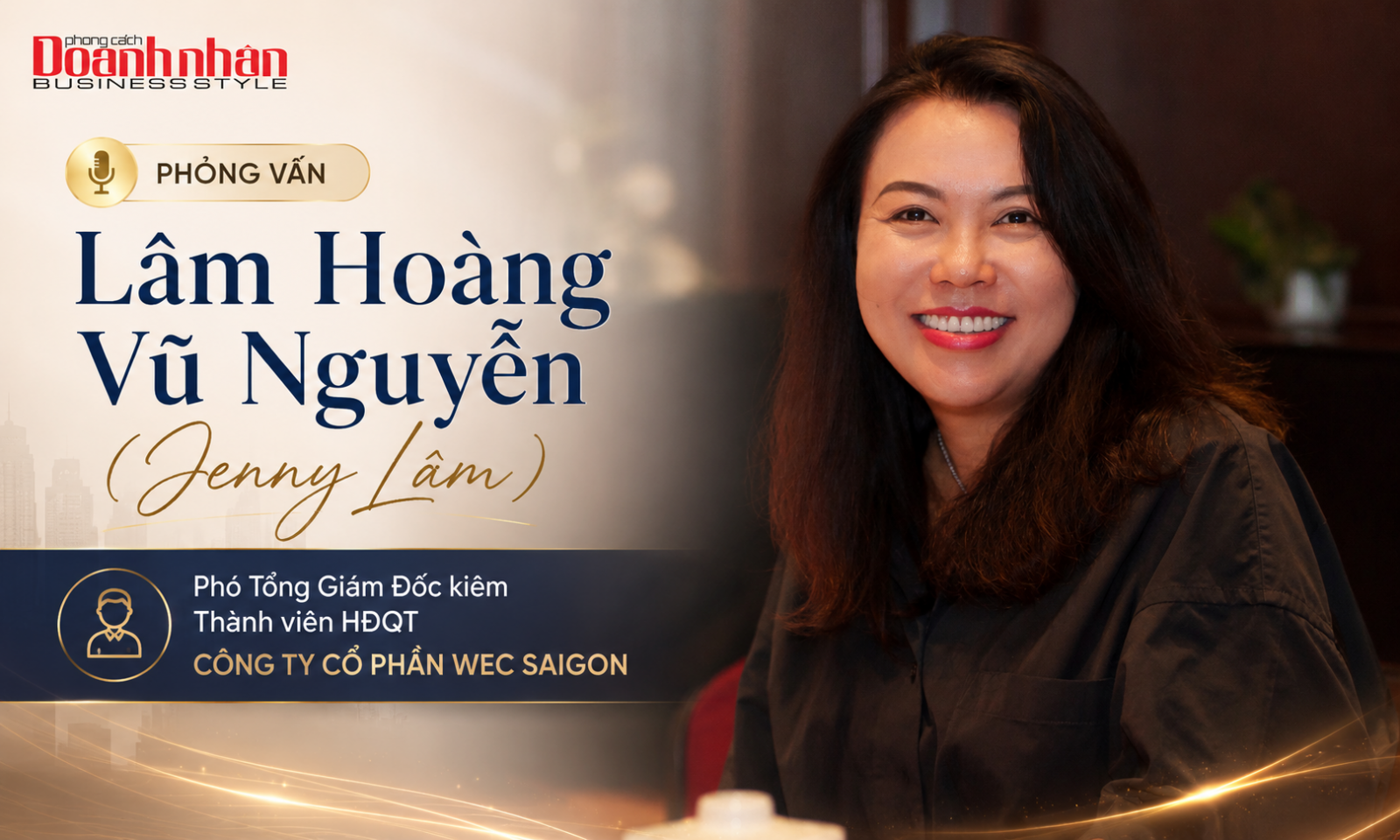
Interviewer: Jenny, what was it like growing up in a family with a strong legacy in Vietnamese banking? How did that shape your view of the business world?
Jenny Lam: In 1993, when I was 14, my parents were among the 20 founding members of a joint-stock commercial bank in Ho Chi Minh City. Two years later, I went to Western Australia to study. Whenever I returned home for the summer holidays, my father would take me to the bank’s events. Although I was young and knew little about finance, listening to the adults around me made the business environment feel very natural.
Before entering banking, my father was the director of a state-owned handicraft export company. From the time I was in third grade, he taught me hand embroidery, showed me how to inspect goods and encouraged me to observe people at work. My mother was originally an obstetrician, but in the early 1990s, she left medicine to establish a company producing embroidered goods for export to Australia and Europe. My childhood was therefore closely intertwined with both my parents’ businesses.
The most valuable thing my family gave me was not a predetermined career path, but professional principles reinforced every day. My father always emphasised that ethics and transparency are the most important foundations in finance. A bank is accountable not only to its shareholders but also to the trust its depositors place in it — something that must never be compromised.
Interviewer: Is there a particular moment or lesson from your family that has stayed with you as a guiding principle?
Jenny Lam: In the final years before leaving the bank he had co-founded, my father told me something I still hold close: “When making a decision that affects many people, do not let it become a source of worry or unease for them. If a decision leaves others feeling insecure, you need to think it through more carefully.”
He also taught me to listen to “weak signals” — those subtle feelings of unease that reason cannot yet fully explain. They are not signs of indecision, but reminders to examine every aspect of an issue before making a choice. We cannot control every outcome, but we remain responsible for whether we can reconcile the consequences of our decisions with our conscience.
Interviewer: Having lived and worked in Melbourne, Australia, from 2003 to 2008, what did you see as the greatest difference between Australian and Vietnamese business cultures?
Jenny Lam: At Westpac, two values were consistently reinforced in my training: integrity — alignment between what we believe, say and do — and transparency in decision-making. I realised that the greatest difference was not in professional expertise, but in how trust is built. In Australia, people place their trust in institutions, systems and processes. In Vietnam, relationships and flexibility play a more important role.
When I returned to Vietnam in 2009, I noticed that there were still “grey areas” in the financial sector. Psychology has a concept called cognitive dissonance: the discomfort that arises when our beliefs and actions no longer align. Having been trained in an environment that valued transparency, I knew I could not be at peace with myself if I remained in that state of conflict for too long. So I chose to stay true to my values rather than continue pursuing senior management positions that did not meet my personal standards.
Interviewer: As a Vietnamese woman from an entrepreneurial family, with experience working in a Western environment, where do you find your own identity?
Jenny Lam: My family and my experience in Australia have profoundly influenced how I think, but neither entirely defines who I am. I believe we are all born with our own temperament. Family and environment nurture us, but our identity ultimately takes shape through our choices and how we respond to life.
My journey has never followed a fixed plan. After several years at Westpac, I thought I would build a long-term career in finance. In 2007, when my father left banking, our family established a securities company, and he hoped I would follow in his footsteps. But life opened up a different path. In 2008, I left the bank to have my first child. When I returned to Vietnam in 2009, I devoted myself fully to my family. The subsequent sale of our family’s securities company brought the path my father had envisioned to a natural close. I began a new chapter as a board member of our family business and an independent investor.
I believe in duyen — the encounters and opportunities that life brings — but I do not believe destiny determines everything. Such encounters may bring us to a door, but how we step through it is our own choice. Those choices are what shape our identity. I live by the spirit of “going with the flow”. To me, that means preparing thoroughly, staying grounded in my core values and calmly embracing what life brings. When a door closes, I do not dwell on regret, because it may be life’s way of opening a more suitable path.
Over the years, I have completed a half-marathon, explored Son Doong Cave and taken up golf. I have always seen each experience as a way to discover my own limits. My current academic journey — from a master’s degree in ESG to a Doctor of Business Administration — has therefore been a delightful surprise. For me, learning is a way to understand people more deeply: what shapes our character, and why we think and make decisions differently. It is a journey of finding answers for myself while broadening my perspective on the world.
Interviewer: What would you like to say to young people deciding whether to carry on a family legacy or forge their own path?
Jenny Lam: Each of us is born into a different family, receives a different education and has different experiences. These shape journeys that are uniquely our own. I do not believe there is a universal formula, or a piece of advice that can apply to everyone, without truly understanding their circumstances. If you come from a family with an established legacy, appreciate the values it has given you, but do not let that legacy limit your other possibilities. And if you do not have an exceptional starting point, do not be too quick to assume you are at a disadvantage.
The most worthwhile investment is in understanding yourself. When you know the values you stand for, your strengths and your limitations, you can make decisions with greater composure, confidence and long-term conviction. Place importance on self-respect: do not use your circumstances as a reason to give up on what you can change, but do not force yourself to live according to other people’s expectations either. For me, living ethically, taking good care of my family and fulfilling my responsibilities well is enough.
Interviewer: Thank you very much for sharing your thoughts.